Building a Global Mobility Engine: Lessons From 1,063 Clients Worldwide
How we built a global mobility engine across four continents, helping 1,063 clients navigate visas, borders, and long-term relocation strategy.
TRAVELEXPATSMALL BUSINESS
Tiffany Garside
2/11/20263 min read
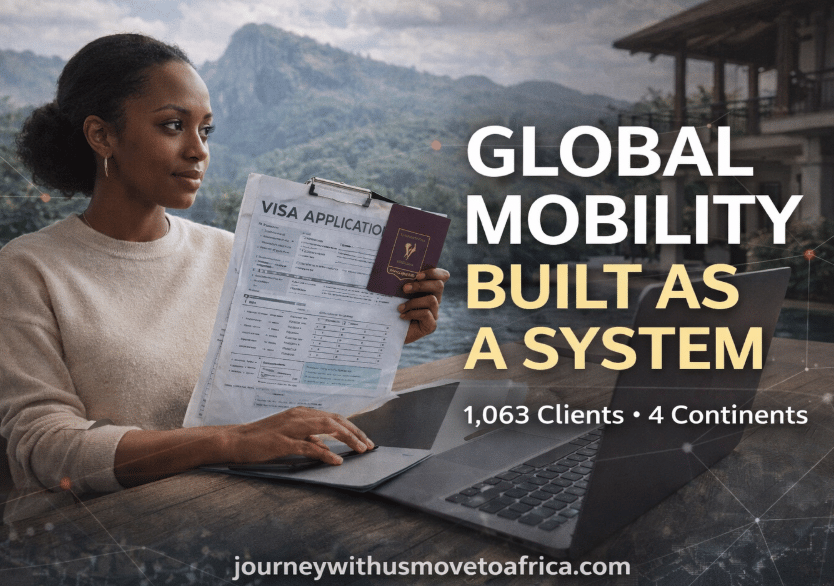
How We Built a Global Mobility Super Engine
1,063 Clients Later, Across 4 Continents
Most people think global mobility is about visas, passports, or moving countries.
It isn’t.
Global mobility is a systems problem—and we learned that the hard way.
Over the last several years, we’ve worked with 1,063 clients across four continents, helping individuals, families, and entrepreneurs navigate relocation, residency, banking, and long-term positioning in an increasingly restrictive world.
What we built along the way wasn’t a travel service.
It was a global mobility engine—one designed to operate before pressure hits, not after.
This is how it came together.
The Problem We Saw Early (That Others Missed)
When we started working with clients internationally, a pattern emerged almost immediately:
People were making single-point decisions in a multi-system world.
They focused on:
One country
One visa
One passport
One escape narrative
But the world was already shifting toward interconnected systems:
Immigration linked to banking
Banking linked to identity
Identity linked to travel
Travel linked to compliance
Moves that worked five or ten years ago were quietly becoming fragile.
We realized something critical:
Mobility without systems literacy creates false security.
So we stopped thinking like travel advisors and started thinking like systems architects.
From Ad Hoc Advice to an Engine
In the beginning, everything was manual.
Each client situation was different:
Different citizenships
Different income structures
Different family needs
Different risk tolerance
But over time, patterns repeated.
We began documenting:
What broke first
Where friction showed up
Which regions offered flexibility
Which decisions aged well—and which didn’t
That documentation became the foundation of the engine.
Not a checklist.
A framework.
What the Global Mobility Super Engine Actually Is
At its core, the engine does three things:
1. It Decouples Identity From Geography
Instead of anchoring everything to one country, the engine separates:
Where you live
Where you earn
Where you bank
Where you hold residency
This creates optionality.
Clients who struggled the most were those who over-integrated too early. Clients who thrived kept distance between systems.
2. It Works in Phases, Not Forever Moves
We stopped selling the idea of “move once and settle forever.”
The world no longer works that way.
The engine operates in phases:
Exploration
Temporary presence
Strategic residency
Long-term positioning
This phased approach allowed clients to adapt as policies, economies, and technologies changed.
3. It Prioritizes System Friction Over Aesthetics
Beautiful destinations don’t matter if:
Banking is unreliable
Internet is inconsistent
Compliance pressure is high
Exit options are limited
We evaluate locations based on:
System density
Policy velocity
Infrastructure resilience
Human-scale governance
This is why our work spans regions like Turkey, South Africa, Mauritius, Dubai, Abu Dhabi, Ghana, and Tanzania—each offering different advantages at different phases.
The Data Behind the Engine
Over time, the engine was tested in the real world:
1,063 clients served since 2021
4+ million YouTube views analyzing global mobility, policy shifts, and economic signals
Clients across Africa, the Middle East, Europe, and Asia
Families, retirees, solo professionals, founders, and diaspora communities
What mattered most wasn’t volume.
It was pattern recognition.
We saw how:
Early movers retained leverage
Late movers faced friction
Flexible earners adapted faster
Over-centralized lives collapsed under pressure
Why the Diaspora Became Central to the Work
The diaspora understands something intuitively that others often don’t:
Belonging is not the same as safety.
Diaspora clients asked better questions:
“How does this age over time?”
“What happens if policy changes?”
“What’s my exit if systems tighten?”
This pushed the engine to mature faster.
We stopped framing mobility as escape and started framing it as resilience.
How Digital ID Changed Everything (Quietly)
Digital identity systems didn’t end mobility—but they changed the rules.
They introduced:
Continuous verification
Pattern-based access
Permission layers that update in real time
The engine adapted by emphasizing:
Redundancy
Low-friction jurisdictions
Temporary pathways over permanent exposure
Banking and residency separation
Clients who understood this transition early moved smoothly. Others felt blindsided.
That gap reinforced why the engine had to exist.
Why This Is a “Super Engine,” Not a Service
Most services answer one question:
“Where should I move?”
The engine answers a different one:
“How do I remain mobile, solvent, and adaptable over time?”
It integrates:
Geography
Policy
Economics
Technology
Human behavior
And it evolves as the world does.
The Biggest Lesson After 1,063 Clients
The biggest myth in global mobility is certainty.
No country is permanent.
No policy is fixed.
No system is neutral.
What works is preparedness.
Clients who succeed long-term are not those who chase the perfect destination—but those who understand how systems interact and keep their lives light enough to adjust.
That is what the engine was built to do.
Where We’re Going Next
As global systems continue to consolidate, mobility will not disappear.
It will become:
More strategic
More layered
More intentional
Our work now focuses on helping people:
Understand timing
Read policy signals
Choose phases wisely
Avoid over-integration too early
Because the future doesn’t belong to those who move fastest.
It belongs to those who move deliberately.
Guidance
🛡️ Build a Life Abroad with Clarity, Not Chaos.
Smart relocatin for families and retirees who want strategy — not sales pitches.
Disclaimer: We are not financial or legal advisors. All content is for educational and entertainment purposes only. Our role is to coach, guide, and equip you to make informed, sovereign decisions. Seek legal counsel for individual advice pertaining to your situation.
Support
journeywithus4u@gmail.com
© 2026. All rights reserved.