The Global Mobility Shift: Why Expats Are Choosing Mauritius Over Bigger African Countries
Increasingly, families, investors & retirees are more aware of a little island nation off the coast of Madagascar. Welcome to Mauritius.
Tiffany Garside
5/11/20266 min read
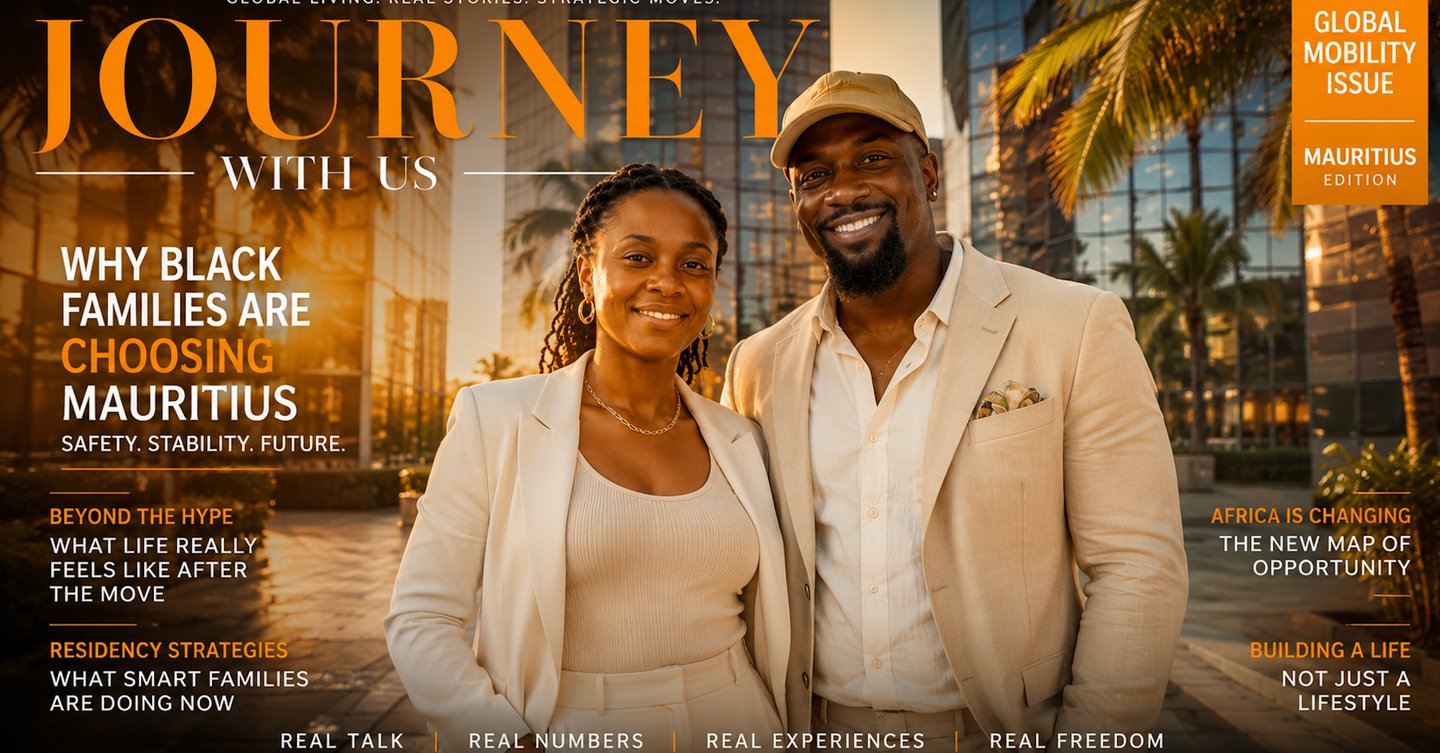

The conversation began quietly, almost accidentally, as most important conversations do.
Without cameras and microphones -- No dramatic music swelling beneath the weight of a revelation.
--- > Just the warm stillness of an ordinary afternoon and the sort of honesty people only offer once they have traveled far enough to stop performing certainty.
A friend of ours is preparing to give birth in Botswana.
Not vacation in Botswana.
Not pass through Botswana.
Give birth there.
There is something profoundly revealing about where a woman chooses to bring life into the world because childbirth strips away fantasy with terrifying efficiency. It forces people to answer questions that glossy relocation videos never touch.
Brutally Honest Questions
Where will I feel safest if something goes wrong?
Where will my nervous system remain calm?
Where can my child begin life without constant fear vibrating invisibly beneath society like faulty electrical wiring behind a wall?
That conversation stayed with me for days because it quietly shattered a narrative that millions of people across the West still carry about Africa. Entire generations were raised to believe the continent existed in a permanent state of instability, as though fifty-four nations and over a billion people could somehow be flattened into one exhausted stereotype. Yet here was a woman calmly preparing to do the most sacred thing imaginable on African soil while many hospitals in America continue grappling with rising maternal mortality rates, staff shortages, burnout, and healthcare costs capable of financially crippling families before the baby even learns to speak.
The irony hung in the air like humidity before rain.
Not long after that conversation, another friend spoke about his years traveling across Africa. Zambia. South Africa. Burkina Faso. Mauritius. Long roads, airports, currencies exchanged beneath fluorescent lights, conversations with strangers who eventually became temporary family. He had seen enough of the continent to speak beyond tourism and beyond aesthetics, and after all that movement, after all those stamps pressed into passports and all those flights cutting across the continent like threads through fabric, only one place continued pulling him back emotionally.
Mauritius.
Not because it was the cheapest.
Not because it was the loudest.
Not because it had the most entertainment.
Because it felt like home.
That distinction matters more than most people realize.
The internet has trained people to evaluate countries the way children evaluate amusement parks. Which place is more exciting? Which city has better nightlife? Which destination stretches a dollar further? Which apartment looks better on camera? Yet eventually a different question emerges, usually after enough exhaustion, heartbreak, overstimulation, economic instability, and global uncertainty have passed through someone’s life.
Where can I breathe properly?
That question changes everything.
A retiree we recently spoke with had traveled through Kenya, Rwanda, and Tanzania before eventually settling on Mauritius as the place he trusted most for long-term stability and peace. Once again, the pattern repeated itself. He did not choose based purely on spectacle or tourism brochures. He chose according to something quieter and infinitely more valuable.
Predictability...
Manage Your Expectations Abroad as an Expat
That word may sound boring to younger audiences trained by algorithms to crave adrenaline every seven seconds, but predictability becomes luxurious once people reach a certain stage in life. Stable electricity grids become luxurious. Low corruption becomes luxurious. Functional banking systems become luxurious. Walking outside without chronic hypervigilance becomes luxurious. Peaceful mornings become luxurious.
And perhaps that is the great shift happening quietly among globally mobile Black families right now. People are no longer simply searching for “better opportunities.” Increasingly, they are searching for environments that do not constantly assault the nervous system.
The Western world, particularly America, has become emotionally expensive.
That truth is difficult to quantify statistically because emotional exhaustion rarely appears neatly inside economic charts, yet millions feel it daily. Inflation creeps through grocery aisles like invisible smoke. Political division infects family conversations. Housing costs rise while trust collapses. Entire cities vibrate with low-grade anxiety. Even success often feels strangely hollow because people are achieving financial milestones inside systems that leave them chronically overstimulated and spiritually exhausted.
Many people do not realize how tense they are until they leave.
The body notices before the mind does.
In Mauritius, mornings unfold differently. The pace is slower, though not unproductive. Children still play outdoors. Families gather publicly. Ocean air moves through neighborhoods carrying the scent of salt and flowering trees instead of traffic fumes and concrete heat. Even silence sounds different here. In many Western cities silence feels suspicious, as though something terrible is moments away from happening. On this island silence often feels restorative.
That distinction changes people slowly.
Not immediately. Slowly.
At first many expats arrive carrying urgency inside their bodies like hidden luggage. They continue checking headlines obsessively. They move too quickly. They consume too much information. They remain psychologically tethered to the chaos they intended to leave behind. Yet after enough months pass, something strange begins happening.
The nervous system softens.
People sleep deeper. Children appear calmer. Conversations lengthen. Meals stop feeling rushed. The body begins relearning safety.
This is why simplistic “Africa is cheap” conversations miss the point entirely.
The Quiet Allure of Mauritius, Africa
Mauritius is not necessarily cheap, particularly for families accustomed to imported Western products, private healthcare, international schools, or luxury conveniences.
As an island nation heavily dependent on imports, prices fluctuate constantly depending on shipping conditions, fuel costs, and global economic instability. Groceries can surprise newcomers. Vehicles cost more than expected. Imported household items arrive carrying the invisible fingerprints of shipping routes and logistics chains stretching across oceans.
Yet people stay.
That is the fascinating part.
They stay because eventually the definition of wealth changes.
In many Western societies wealth has become synonymous with visible consumption. Bigger houses. Faster cars. Endless entertainment. Constant stimulation. Yet after years abroad many families begin measuring wealth differently.
Can my children walk outside peacefully?
Can I think clearly here?
Can I age here gracefully?
Can I hear birds instead of sirens?
Can I build something meaningful without feeling psychologically hunted every day?
Those questions reshape entire lives.
Botswana, Rwanda, Mauritius, Tanzania, Kenya, Zambia, and parts of Southern Africa are increasingly entering conversations among globally mobile Black families because people are beginning to compare emotional quality of life rather than simply comparing salaries.
Rwanda’s cleanliness and order surprise many visitors accustomed to outdated media portrayals of Africa. Botswana continues earning respect for political stability and comparatively low corruption levels. Tanzania attracts families seeking space, slower living, and connection to land. Mauritius quietly draws retirees, entrepreneurs, and families searching for infrastructure combined with calm.
None of these places are perfect.
No country is.
But perfection was never the real objective.
People are searching for alignment.
That is a far more sophisticated pursuit.
One of the most revealing things about long-term travel is that excitement eventually loses its grip on the human psyche. At twenty-two years old people often prioritize novelty. They chase movement itself. Different clubs. Different countries. Different stories to post online. Yet after enough years pass many begin prioritizing something almost embarrassingly simple.
Peace.
And peace is strangely difficult to market because it does not scream. It does not perform. It does not go viral as easily as panic does. Peace often looks ordinary from the outside. Morning coffee beside ocean air. Children laughing indoors. Quiet roads. Familiar routines. Functional systems. Neighbors who know one another. Safety becoming so normal it disappears into the background of daily life.
Yet that ordinary stability becomes profoundly attractive once people experience enough instability elsewhere.
Entering a Global Conversation
The global conversation around Africa is changing whether mainstream media fully recognizes it yet or not.
According to United Nations projections, Africa’s population is expected to approach 2.5 billion by 2050, making it one of the fastest-growing regions in the world. Technology investment, mobile banking systems, AI integration, international trade corridors, energy infrastructure, and geopolitical competition are reshaping the continent rapidly. The outdated image many foreigners still carry about Africa increasingly collides with reality once they arrive and encounter modern banking apps, luxury developments, high-speed internet, entrepreneurial ecosystems, and globally connected professionals building entirely new futures.
Of course, growth creates tension too.
Prices rise.
Foreign investment reshapes neighborhoods.
Tourism changes local economies.
Imported inflation spreads.
No place remains untouched by globalization indefinitely.
But even with those realities, something deeper continues drawing people toward certain African countries and islands. It is not merely economics. It is emotional architecture.
Some environments exhaust people. Others restore them.
That truth sits quietly beneath nearly every relocation conversation we have nowadays.
The retiree choosing Mauritius over larger African nations was not simply choosing an island. He was choosing emotional steadiness. The traveler who explored multiple countries before emotionally anchoring himself to Mauritius was not simply choosing scenery. He was choosing internal peace. The woman giving birth in Botswana was not simply selecting a hospital. She was selecting the atmosphere surrounding the first breath her child would take.
Those are deeply human decisions.
And perhaps that is the real story emerging now among the diaspora.
Black families are no longer merely asking where they can survive.
Increasingly, they are asking where they can heal.
Where they can age.
Where they can raise children.
Where they can preserve sanity.
Where they can think clearly enough to imagine a future again.
Those are entirely different questions from the ones dominating internet discourse only a few years ago.
The world has changed rapidly.
The pandemic accelerated remote work. Geopolitical tensions increased. Inflation exposed the fragility of many economies.
Trust in institutions weakened. Entire populations began quietly reevaluating what mattered most.
And somewhere within all that uncertainty, islands like Mauritius began attracting people seeking something extraordinarily rare in the modern era:
stillness.
Not isolation.
Stillness.
The kind capable of allowing a human being to hear themselves think again.
Guidance
🛡️ Build a Life Abroad with Clarity, Not Chaos.
Smart relocatin for families and retirees who want strategy — not sales pitches.
Disclaimer: We are not financial or legal advisors. All content is for educational and entertainment purposes only. Our role is to coach, guide, and equip you to make informed, sovereign decisions. Seek legal counsel for individual advice pertaining to your situation.
Support
journeywithus4u@gmail.com
© 2026. All rights reserved.